


Flu season comes around every year, and with it the question of how best to protect your child.
The good news is that you now have options – and we're here to help you understand them.
Influenza (‘the flu’) can be very serious:
Annual vaccination is the best protection
Influenza is the most common vaccine-preventable disease in Australia.
In children, particularly young children, it can be very serious. Every year, thousands of Australian children – most of them under 5 years of age – become so sick from influenza that they are admitted to hospital.
Vaccinating your child before the start of winter is the best way to help protect them against influenza. It is important to do this each and every year because influenza vaccines are updated to address the strains most likely to spread in the community that flu season.
Pick Your Protection from the childhood influenza vaccination options below and discuss next steps with your doctor, nurse or pharmacist.
The Immunisation Foundation of Australia supports choice in vaccination. What matters most is that your child is vaccinated.
Protecting children against influenza
Vaccination against influenza is recommended for all Australians over 6 months of age.
All children should be vaccinated against influenza, particularly those who are most likely to develop serious complications from the virus, including:
Children aged 6 months to 5 years of age
Children of any age with certain medical conditions, including severe asthma, diabetes, cancer, immune disorders, obesity, kidney, heart, lung or liver disease.
Influenza spreads rapidly among children, especially in childcare centres, schools and social settings. This is partly because children can pass on the virus for up to two weeks – much longer than in adults.

Although school-aged children are less likely to become very sick from influenza, vaccination helps to protect not only them, but also family, friends and the rest of the community.
Additionally, vaccinating children against influenza reduces missed days of school and childcare. It also helps to reduce the amount of time parents may need to take off work to care for sick children.

Influenza in children is serious
Influenza is a serious and highly contagious virus. It is one of the main reasons children are admitted to hospitals in Australia every year.
While many children recover at home, influenza can cause severe complications such as breathing difficulties and lung infections (such as pneumonia). In serious cases, it can be life-threatening.
It is important to understand that, while they may have similar symptoms, influenza is very different to the common cold. Influenza comes on much stronger, is more severe, and often lasts longer than a cold.
Influenza symptoms include:
Sore throat
Runny or stuffy nose
Severe dry cough
Headache
Fever (often with chills)
Aches and pains
Tiredness and fatigue
Nausea, vomiting and/or diarrhoea

Seek medical attention if your child has influenza and:
Is breathing faster or harder than usual
Is paler than usual and sleepy
Appears very unwell
Has a bad headache
Can’t or won’t drink fluids
Vomits frequently
Doesn’t show improvement within 48 hours
Influenza vaccination means children are less likely to contract influenza, less likely to develop serious complications such as breathing difficulties or lung infections, and less likely to be admitted to hospital with the virus.
Pick your protection this flu season
The best way to protect your child from influenza is to have them vaccinated. In Australia, there are two influenza vaccination options that can help protect children from the virus:
Injected influenza vaccine (administered via a needle)
Nasal spray influenza vaccine (administered via a spray up both nostrils)
They both offer children strong protection against common strains of influenza but are delivered in different ways.

The injected influenza vaccine
The injected influenza vaccine has been used safely in Australia and around the world for decades.
Commonly known as the ‘flu shot’, this vaccine is delivered via a quick injection into the upper arm or thigh of a child.
It is designed to help protect children aged 6 months or older against commonly circulating strains of the influenza virus.
It can be given by a GP or nurse, or by a pharmacist in some states. The injected vaccine can be given at the same time as other routine childhood vaccines without affecting the effectiveness or safety of any of the vaccines.
Program eligibility shown as at 1 July 2026. All 2026 state nasal spray programs have now finished, and WA’s free injected program closed on 31 July. Queensland’s free injected flu vaccine runs until 30 September. The nasal spray vaccine is still available privately for children aged 2 to 17, and free injected vaccines remain available under the National Immunisation Program for children aged 6 months to under 5 and other eligible groups. We will update this page as soon as 2027 programs are announced.
Funded nationally:
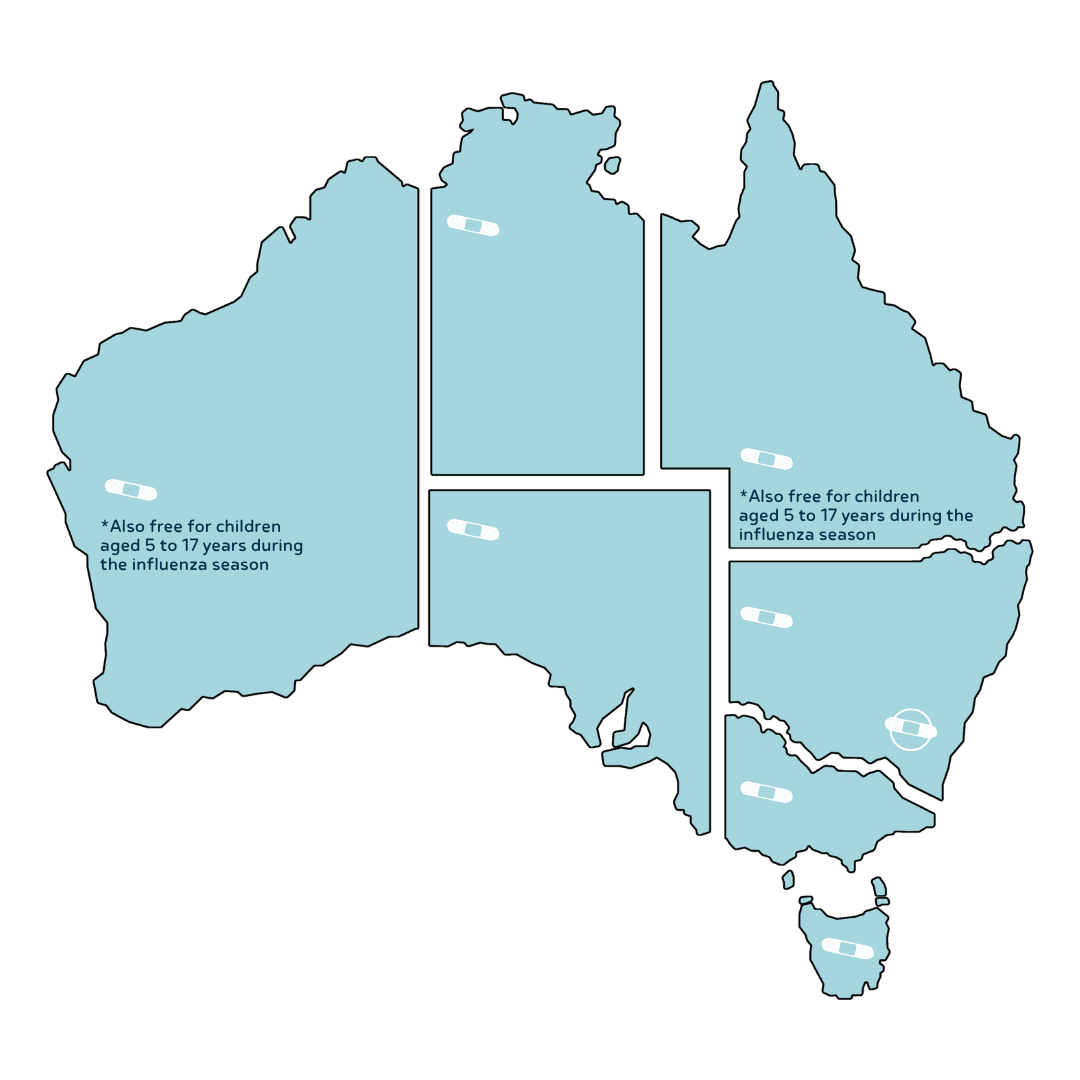
Nationwide:
Free for children aged 6 months to 4 years
Free for Aboriginal and Torres Strait Islander children (6+ months)
Free for children (6+ months) with a medical condition that puts them at greater risk of complications from influenza
QLD
Also free for children aged 5 to 17 years during the influenza season. Free for everyone from 6 months, 1 March to 30 September.
WA:
Also free for children aged 5 to 17 years during the influenza season. Free for ages 5 to 64, 1 May to 31 July.
NSW, SA, VIC, TAS, ACT, NT:
NIP only

The nasal spray influenza vaccine
While new to Australia in 2026, the nasal spray influenza vaccine has been used safely in millions of children overseas for more than 20 years.
This needle-free vaccine is sprayed into each nostril, where the immune system gets to work – right at the point where the influenza virus most commonly enters the body.
It is designed to help protect children aged 2 to 17 years against commonly circulating strains of the influenza virus.
The nasal spray vaccine can be given by a GP or nurse, or by a pharmacist in certain states.
If your child sneezes or their nose runs after the nasal spray, the vaccine still works and the dose does not need repeating. If they have a blocked or runny nose on the day, ask your provider about waiting a few days or having the injection instead.
The nasal spray vaccine is not suitable for all children. Speak to your doctor, nurse or pharmacist if your child has a weakened immune system, certain allergies, or other health conditions.
Program eligibility shown as at 1 July 2026. All 2026 state nasal spray programs have now finished, and WA’s free injected program closed on 31 July. Queensland’s free injected flu vaccine runs until 30 September. The nasal spray vaccine is still available privately for children aged 2 to 17, and free injected vaccines remain available under the National Immunisation Program for children aged 6 months to under 5 and other eligible groups. We will update this page as soon as 2027 programs are announced.
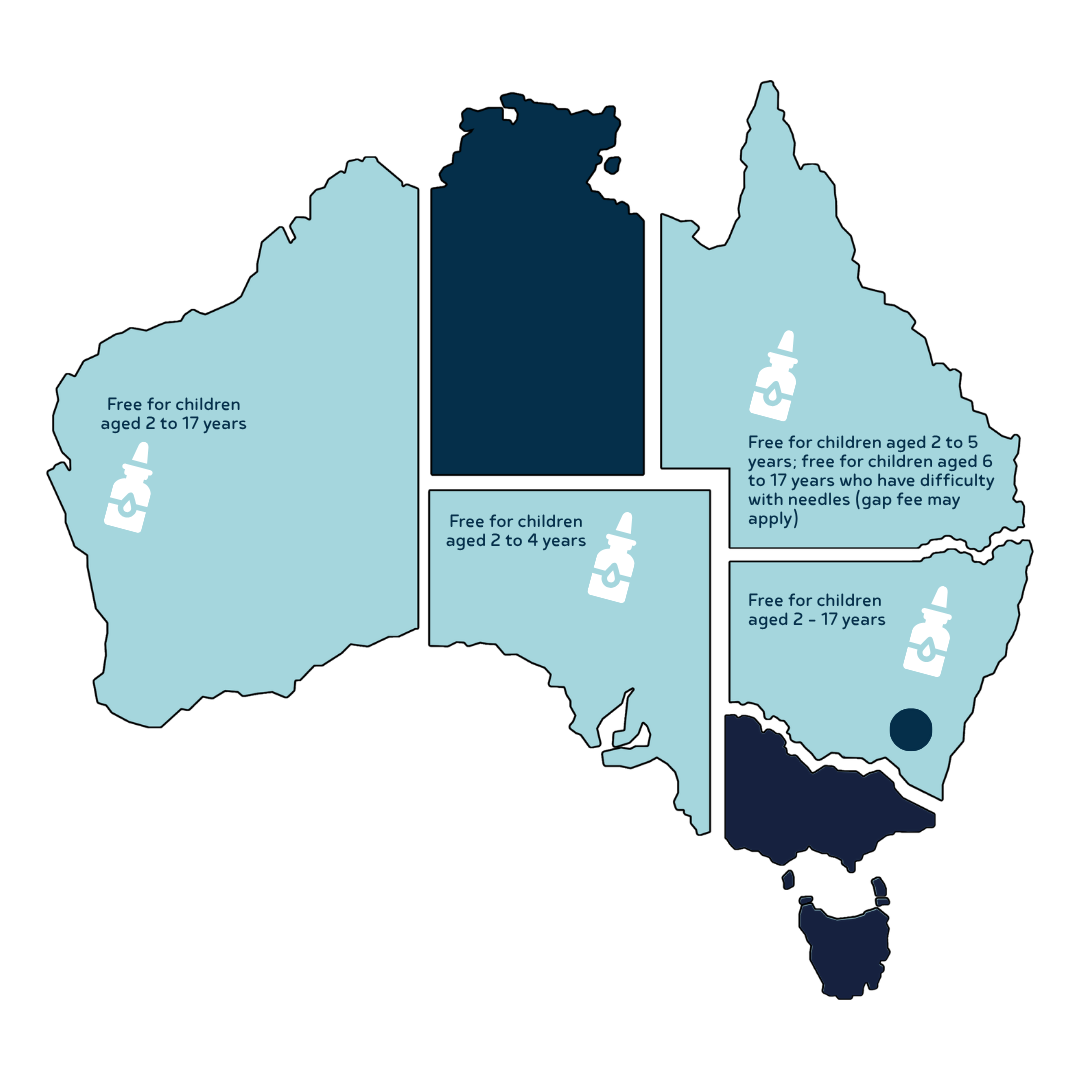
Funded in some states:
NSW
Free for children 2 to 4 years from April; expanded to 2 to 17 years on 22 May 2026.
Limited-time program; last state stock expired 10 July
SA
Free for children 2 to under 5.
Ended 31 July
QLD
Free for children aged 2 to 5 years; Free 2 to 5, plus 6 to 17 who struggle with needles.
Nasal spray ended 7 Aug; injected runs to 30 Sep
WA:
Free 2 to 11 from 14 April; expanded to 2 to 17 in July.
Both programs ended 31 July (nasal stock usable to 7 Aug)
VIC, TAS, ACT, NT:
No funded program; private only (about $50 to $75).
Download
Download
Want something to read later, or share with a friend? Our free Pick Your Protection brochure covers everything you need to know about protecting your child from influenza this flu season, including the two vaccine options now available in Australia.

Ready to protect your child this flu season?

Still have questions? Start with our FAQ below, or speak to your doctor, nurse or pharmacist.
Whichever option you choose, the most important thing is that your child is protected against influenza.
Parents often ask us
...
Parents often ask us ...
-
Yes, a child can usually receive the influenza vaccine if they have a mild illness, such as a slight cold, runny nose, or low-grade fever. However, if your child has a high fever (38.5°C or above) or a more serious illness, it is recommended to wait until they are feeling better. Speak to your doctor, nurse or pharmacist if you have any questions.
-
Children generally need one dose of the influenza vaccine each year. However, if your child is being vaccinated against influenza for the first time, they may need two doses depending on their age and health. Speak to your doctor, nurse or pharmacist to find out what's right for your child.
-
Yes, your child can have an influenza vaccine at the same time as other routine childhood vaccinations without affecting the safety or effectiveness of any of the vaccines.
-
Whether your child has the injection or nasal spray, the vaccination works in a similar way. These vaccines work by exposing your child’s immune system to an inactive or weakened form of the influenza virus, teaching their body to recognise and fight the virus without causing the illness.
-
Children should be vaccinated every year to help protect them against the most common strains of influenza that flu season (influenza strains change each year). In Australia, the best time to get vaccinated is in April or May, as the weather starts to cool but before the typical flu season (June to September) begins.
-
Your child can receive either the injected or nasal spray influenza vaccine from a GP or nurse. In most states, pharmacists can also administer influenza vaccines, however age restrictions apply – check with your local pharmacy. Use the healthdirect service finder to find your nearest vaccination clinic, GP or pharmacy.
-
Influenza vaccines are extensively studied and used by millions of people, including children, worldwide. The injected and nasal spray influenza vaccines are both proven to be safe and well tolerated. While the nasal spray vaccine is new in Australia, it has been used overseas for more than 20 years.
After vaccination, mild symptoms similar to the early stages of influenza (such as a runny nose, tiredness or muscle aches) may develop. These are generally mild and only last 1-2 days.
-
The injected and nasal spray influenza vaccines are both well tolerated. After receiving the injected vaccine, some children experience soreness, redness or mild swelling at the injection site, which usually settles within a day or two. After receiving the nasal spray, a runny or blocked nose is the most common reaction.
With either vaccine, some children develop mild flu-like symptoms such as tiredness or a low-grade fever. These are signs the immune system is responding and generally resolve quickly. Serious reactions are extremely rare. If you have any concerns after vaccination, speak to your doctor, nurse or pharmacist.
-
Pregnant women can receive an influenza vaccine at any stage of pregnancy, at no cost.
This is the best way to protect newborns against influenza. However, the protection passed to the baby from the mother gradually wanes over the first months of life, which is why the influenza vaccine is recommended for children from 6 months of age.
-
Yes, all Australians over the age of 6 months should be vaccinated against influenza every year. This is because the vaccines are different each year, tailored to address the strains of influenza commonly circulating within the community.
-
Parents and carers can also try their best to reduce the risk of their child contracting influenza through good hygiene, such as handwashing, covering coughs and sneezes, and staying away from others who have the virus.
Pick Your Protection is supported by an unrestricted educational grant from AstraZeneca. AstraZeneca had no involvement in the content of this page.